

Courses on repairing engine control units for a variety of vehicles (the most common problems and solutions are described) – from Automotive, Engine, control, unit, ECM, Repair,Training, Courses, Variety, vehicles,, 2018.
– You will learn how to fix the main problem with instrument clusters on the Audi A6 C5, first-generation Audi TT, A3 of the same years, and the Mercedes Vito. This applies to situations when the cluster malfunctions, the needles sometimes work, sometimes don’t, the display and backlight behave erratically. And sometimes the car may even fail to start.
– Every 220 Mercedes will sooner or later experience a failure of the door seat control module. That’s just how it’s designed and constructed… I’ve seen many attempts to repair these modules. But there’s only one truth. Once you know it, you can easily guarantee at least a year that the problem won’t recur.
– ABS modules on Audi, BMW, and Volkswagen. Bosch clearly took advantage of owners by incorporating inevitable failures into the design of their control units. I’m talking about units on ceramic boards. I’ll explain the problems and share my experience repairing them.
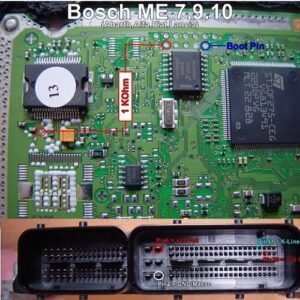
– On the first production Mercedes-Benz models of the new generation, such as the 221 and ML164, the BOSCH ME9.7 engine control units were mounted directly on the engine. As a result, every car with this unit placement slowly begins to fail. The car behaves unpredictably, jerks, stalls, or doesn’t start at all. I’ll explain the root cause of the problem and teach you how to fix it.
– Another very common problem with early Mercedes-Benz models (202 and 210), and, oddly enough, some SsangYongs, is the loss of spark on a couple of cylinders. This applies to all cars with HFM control units. Many people on forums are struggling with this issue. Some people succeed, others don’t. I’ll teach you how to fix it!
– Some Ford Focus 2s were equipped with instrument clusters that would eventually start acting erratically. These included strange messages on the display, blinking lights, crazy needles, and the like. This problem can be solved fairly quickly if you know how. You’ll learn about it in this course.
– Mitsubishi vehicles such as the Pajero, Montero, Space Star, Space Wagon, and others with black plastic control units often had one of the ignition control channels fail. Unfortunately, the unit uses purely Japanese components, which have no equivalents. But I found a solution: using two transistors for 5 rubles each, I replaced this tricky component. Now you can find out too!
– Nissan Maxima, Almera, Primera, Sunny, several Infiniti models, and several other models have a number of problems with their control units. First, there’s idle speed failure. When the car either completely loses it or can’t regulate it. This stems from factory engine design features. These same cars almost equally often have ignition problems. One or more cylinders fail, resulting in a misfiring engine. I’ll teach you how to repair Nissan control units with these issues.
– If the transmission on a second-generation RAV4 jerks, gears shift inappropriately, or solenoid errors pop up, then in almost 100% of cases the problem is with the control unit. You’ll learn how to completely fix this.
– The first-generation Skoda Octavia has this problem. All the needles on the instrument panel simply fall off and lie there, showing no signs of life. Sometimes they might twitch a couple of times, but then they settle again. I’ll show you how to quickly and reliably fix this problem.
– Another common malfunction is instrument cluster failure on Volvo S60, S80, and XC90 vehicles. These are just the ones I’ve encountered. There are likely other models with similar issues. The hands don’t move, the screens are silent, the lights are on. That’s roughly what the problem looks like from the outside. I have a proven, ready-made solution for fixing these problems. And I’m ready to share it with you!
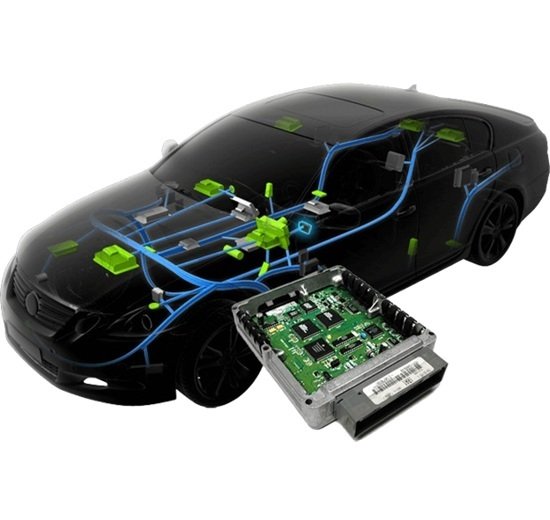
Engine Control Unit (ECU) and Electronic Control Module (ECM) repair courses teach you how to diagnose, program, and physically fix the main computers found in a wide variety of vehicles, including passenger cars, commercial trucks, and motorcycles. These programs bridge the gap between traditional auto mechanics and micro-electronics engineering, heavily focusing on multi-vehicle compatibility.
📋 Core Skills Covered for Different Vehicle Types
A comprehensive, multi-vehicle course covers issues unique to different classes of transit:
| Vehicle Class | Focus Areas Covered in Courses | Common Diagnostic Tools Used |
| Passenger Cars | Key transponder pairing, Immobilizer (IMMO) systems, airbag module resets, and body control logic. | KTAG, OBD Scanners, Digital Oscilloscopes. |
| Commercial Trucks | Heavy-duty 24V power distribution, diesel fuel injector profiling, and high-vibration circuit board failure points. | Heavy-duty multi-brand simulators, Multimeters. |
| Motorcycles / Bikes | Compact weatherproof board architectures, ignition pulse timing logic, and performance remapping. | Micro-soldering stations, Bench flashers. |
🔍 Standard Multi-Vehicle Curriculum Framework
- Hardware Diagnostics: Learning to trace the power supply matrix (12V/5V rails), check grounding, and find shorted regulator ICs.
- SMD Board Repair: Mastery of soldering and desoldering micro-chips, capacitors, and multi-pin vehicle drivers.
- ECU Remapping & Cloning: Backing up EEPROM files, cloning damaged boards to donor units, and unlocking speed delimiters.
- Cross-System Training: Integrating ECU diagnostics with anti-lock braking systems (ABS), electronic power steering (EPS), and digital dash clusters.
💡 Learn More
- Diagnostic Logic: In modern vehicle repair, checking the 12V and 5V internal power distribution is considered the fundamental first step before testing any sensors or replacing board chips.
- The Clone Route: Instead of buying expensive new factory computers, technicians learn to clone old vehicle firmware onto generic, used circuit boards, saving clients thousands of dollars.
If you are trying to select the right training option, let me know:
- Your current skill level (Are you a beginner or an experienced mechanic?)
- Your preferred learning format (Are you looking for online video modules or physical, hands-on workshops?)
- Your geographic location or target region (so I can recommend highly-rated local academies nearby)


Reviews
There are no reviews yet.