

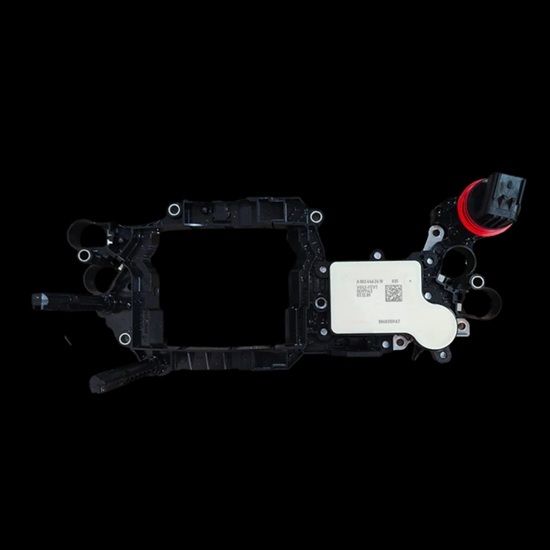

Mercedes A-Class W169 and B-Class W245 VGS 722.8 transmission (CVT) repair technology for vehicles with solenoids and input/output shaft sensors. This repair includes a detailed description of the process, materials used, photographs, descriptions of replacement components, and links to purchase them at competitive prices.
The repair cost for these circuit boards starts at 500Aed. For sensor issues, the cost is up to 1,000 AED.
The Mercedes-Benz 722.8 Autotronic CVT (Continuously Variable Transmission) used in the A-Class (W169) and B-Class (W245) suffers from a notorious design flaw where the Temic VGS Transmission Control Module (TCM) fails due to thermal stress and broken internal micro-bonds. This guide details the technical repair process for the TCM electronics and the mechanical variator (pulley/belt) assembly.
⚠️ Common Symptoms & Diagnostic Codes
When the 722.8 TCM or variator fails, the vehicle enters Limp Home Mode and displays a “Transmission visit workshop” dashboard message.
- P0793 / 0793: The RPM signal from component Y3/9b4 (CVT secondary RPM sensor) is unavailable.
- P0722 / 0722: The RPM signal from component Y3/9b5 (CVT output RPM sensor) is unavailable.
- P0896: Impermissible continuous variable transmission ratio
🛠️ Part 1: TCM (Conductor Plate) Repair Technology
The TCM sits inside the transmission oil pan, directly exposed to hot gear oil. Over time, the factory aluminum wire bonds connecting the speed sensors and gear selector to the circuit board snap due to vibrations and heat cycles.
- Removal Process
- Drain the transmission fluid and remove the transmission oil pan and filter.
- Unbolt the hydraulic valve body from the transmission casing.
- Carefully detach the plastic Temic VGS TCM module from the top of the valve body.
- Micro-Soldering Restorations
- Open the Casing: Use a plastic cutting tool or a precise heat-knife to cut through the factory-sealed plastic cover of the TCM.
- Remove the Gel: Clean away the protective silicone/gel layer covering the micro-circuitry using dedicated electronic solvent.
- Scrape and Tin: Locate the 11 broken aluminum connections linked to the speed sensors (Y3/9b4 / Y3/9b5) and the gear selector module. Carefully scrape away the oxide layer from the underlying contacts.
- Solder Jumpers: Use flexible copper jumper wires instead of rigid aluminum. Solder them with a high-quality flux and temperature-regulated soldering iron. Leave a slight loop/slack in the wire to handle future thermal expansion and vibrations.
- Reseal: Apply new electronic protective silicone gel over the board, seat the plastic lid, and plastic-weld or epoxy the cover back to air-tight status.
⚙️ Part 2: Transmission Variator & Belt Repair
If the problem is mechanical (slipping gears or ratio errors like P0896), the variator system itself needs physical rebuilding.
[Engine Torque] ──> [Primary Variator (Pulley)] ──> [Bosch Pushing Belt] ──> [Secondary Variator (Pulley)] ──> [Wheels]- Variator Inspection & Machining
- The 722.8 uses two conical variator pulleys that change diameter to alter gear ratios.
- Inspect the pulley surfaces for deep scoring, grooves, or metal pitting caused by a slipping belt or contaminated oil.
- If damaged, the pulleys must be removed and lathed on a high-precision grinding machine to restore a mirror-smooth finish. If worn beyond specifications, the entire variator assembly requires replacement.
- Belt Replacement
- The variator relies on a heavy-duty Bosch-originated “pushing” metallic belt.
- A worn belt stretches or sheds individual metal friction elements, destroying the pulleys.
- Always replace the belt during a variator overhaul. Ensure the replacement matches the exact dimensions of the 722.8 transmission and is oriented in the correct rotating direction during installation.
- High-Pressure Pump & Hydraulics
- The Mercedes 722.8 utilizes a highly reliable rotary-type oil pump that generates massive hydraulic pressure to pinch the variator pulleys tightly onto the belt.
- Thoroughly clean the valve body channels. Replace the pressure control solenoids if they stick or show resistance out of spec.
💧 Part 3: Reassembly & Transmission Fluid Service
Precision fluid management is critical to prevent immediate failure of the newly repaired variator components.
- Fluid Specification: Fill exclusively with ATF 28-CVT (such as Fuchs Titan CVT). Standard automatic transmission fluid (ATF) will cause immediate belt slippage and ruin the variators.
- Fluid Capacity: The system takes roughly 5 to 5.5 liters.
- Filter Change: Always replace the oil pan gasket and the internal ATF 28-CVT type oil filter.
If you are performing this repair yourself, let me know if you need the exact wiring pinout diagrams for the TCM speed sensors, or the torque specifications for bolting the valve body back onto the transmission casing.
Be the first to review “Mercedes A class and B class VGS 722.8 TCM Transmission Variator Repair Technology Tutorial”
Related products




Reviews
There are no reviews yet.