

About CAT,SAI, DPF, EGR, AdBlue deactivations
Removing the catalyst (CAT)
Removing the catalytic converter, updating the Euro-2 engine, disabling or tampering with the second lambda probe
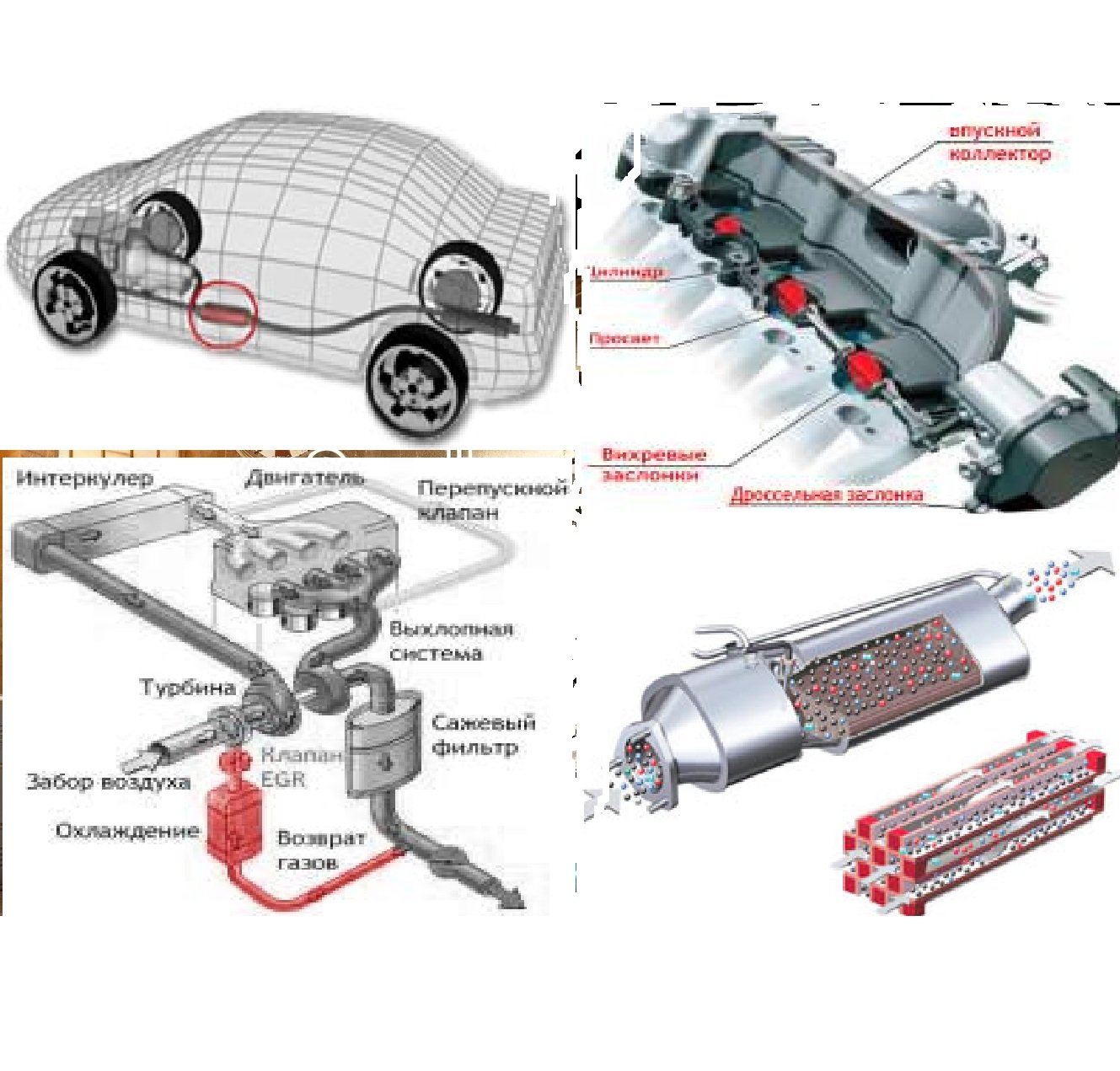
A catalytic converter is an essential part of a modern car. With its porous structure and large contact area with exhaust gases, it burns unburned exhaust gases into less harmful compounds. Containing rather expensive metals, a new catalytic converter can cost around a thousand dollars. and a car may have up to four of these components.
Over time, a catalytic converter can fail. Early on, the Check Engine light appears, followed by poor performance and increased fuel consumption. A buildup of oxidation products reduces the catalytic converter’s capacity, increasing the flow rate and temperature of the exhaust gases. Eventually, the catalytic converter begins to deteriorate, and fragments can clog the porous structure of both the converter itself and subsequent converters, or even the muffler. All this significantly impairs engine performance and can even render the vehicle unusable.
In this situation, it is necessary to either replace the catalytic converter or remove it and convert it to Euro 2 emissions.
Important! All vehicles with an active Check Engine light must be diagnosed before any further work is performed!
All faults in other systems are repairable and can cause a malfunction even if our services are performed correctly.
Fake oxygen sensor or Euro-2 program
A second oxygen sensor dummy is the cheapest solution, but it’s neither particularly reliable nor complete. Firstly, it may require repeated calibration, and without precise tuning, the car will continue to display the Check Engine light with codes related to the catalytic converter. Secondly, it requires a working oxygen sensor, which also needs to be replaced if it fails.
The Euro-2 program is somewhat more expensive, but this is only at first glance. Firstly, you can disable or physically remove the second oxygen sensors after the catalytic converter. Secondly, the program guarantees proper operation; the car won’t display the Check Engine light for the catalytic converters and their sensors or go into emergency mode with increased fuel consumption. And thirdly, it gives you peace of mind during pre-sale preparation of the car, when any such issues can affect the price or even discourage the buyer.
EGR (gas recirculation system) removal
Exhaust gas recirculation (EGR) is the most common failure of exhaust gas recirculation systems (or AGR in German). The EGR valve returns heated gases from the exhaust system to the intake manifold. Its primary purpose is to increase the temperature of the gas mixture entering the engine, which reduces the formation of various nitrogen oxides. However, over time, soot particles accumulate in the intake manifold, and the air flow sensors or the valve itself may become inoperative. This leads to diagnostic errors and the vehicle entering emergency mode. Bosch control units can perform this entirely programmatically— disabling the EGR valve without mechanical intervention , meaning there’s no need to even mechanically shut off recirculation. In other cases, it’s only possible to shut off recirculation to zero , while the valve’s clearance is still mechanically closed. A third option is to disconnect the EGR connector, leaving the valve simply closed. This method is available on all types of ECUs and also requires a proper software update.
Removing swirl flaps
Intake manifold swirl flaps (or IMRCs – Intake Manifold Runner Controllers) help distribute the gas flow for optimal combustion. This is common in diesel engines, and is also common in gasoline engines for example, in the VAG series of FSI (Fuel Stratified Injection) engines and turbocharged versions of TFSI/TSI engines. Overall, the system slightly improves the engine’s environmental friendliness and fuel efficiency, but not so significantly that it requires replacing an expensive part if it fails. This is most often seen in diesel engines when a certain amount of soot from the exhaust gas recirculation system ends up in the intake.
When the IMRCs become stuck closed, the intake system’s flow capacity is insufficient the car produces increased smoke and loses some power. The Check Engine light comes on the dashboard, and the car may go into limp mode.
Naturally, the most reliable option is to remove the IMRCs and disassemble the intake manifold. There are quick, temporary fixes that can lock the swirl flaps open without disassembling them. This involves removing the actuators and locking them open from the outside (their operation is visible under the hood when the ignition is turned on). However, this doesn’t guarantee a solution, as over time, the plastic flaps can disintegrate and fall into the engine.
Therefore, we offer only a complete solution: removing the swirl flaps from the intake manifold and updating the engine software to ensure proper operation in this mode.
Disabling secondary air, absorber and crankcase ventilation
The Secondary Air Injection (SAI) system is activated when the engine is cold and forces atmospheric air into the exhaust tract behind the exhaust valves for 1-2 minutes. This oxygenates the exhaust gases, initiates afterburning, and accelerates catalytic converter heating. The engine control unit controls the SAI system via the secondary air pump relay and air valves. With each subsequent engine start, the SAI system is activated at idle for 10 seconds.
If the system malfunctions, the cost of repair can significantly exceed the estimated benefit, so troubleshooting secondary air injection errors is often necessary. No mechanical intervention is required; a plug can be installed over the pump or valve clearance, if desired.
The crankcase ventilation system is designed to reduce fuel vapor emissions into the atmosphere. Crankcase ventilation in naturally aspirated engines is achieved by creating a vacuum in the intake manifold, while in turbocharged engines it is achieved through throttle control. If the system malfunctions, no significant operational changes may be noticed, only a malfunction indicator lamp. The output of specific codes in the alert can be disabled through a software update without any mechanical intervention.
There’s also a system for removing excess gases from the fuel tank, equipped with a catching element called an absorber. Like any filter element, it can fail and require repair. If repair is difficult, you can also remove the absorber and disable the specific codes for this system.
Important! All vehicles with an active Check Engine light must undergo diagnostics before any further work is performed!
All faults in other systems are repairable and can independently trigger the emergency mode, regardless of other shutdowns.
Remove the diesel particulate filter
If the diesel particulate filter (DPF Diesel particulate filter / FAP Filter Additive Particulate) becomes heavily clogged and fails, power drops, fuel consumption increases, and the Check Engine light comes on. There are two options: either replace the expensive spare part or remove the diesel particulate filter from both the software and the exhaust system. The second solution is several times cheaper, but first requires a high-quality software update. Often, proper operation is guaranteed with all working and connected sensors, even despite software disabling or emulation. Only in some cases does the mechanical component also need to be disconnected from the differential pressure and/or exhaust temperature sensor connectors.
Another option for our customers is software emulation of a working diesel particulate filter . This involves modifying the operating code so that any readings from the sensors monitoring the diesel particulate filter are perceived as normal and will not lead to errors or regeneration. This primarily involves emulating the operation of the differential pressure and exhaust temperature sensors.
Attention! All vehicles with an active Check Engine light must undergo a diagnostic before any further work is performed! All other system malfunctions are repairable and can cause a limp mode even if our services are performed correctly. Unless otherwise stated, after mechanical removal, all sensors should be left in place, and the integrity of the wiring and the proper flow of all tubular connections should be checked.
Software deactivation of the diesel particulate filter and mechanical removal
A software solution for diesel particulate filters is always combined with mechanical intervention; otherwise, the porous elements will continue to accumulate deposits, leading to the same problems. We support virtually all vehicles, and pricing can be calculated by clicking on any line in the passenger car and heavy equipment catalog.
Our solutions include the most common codes and also take into account all current diagnostic faults, without affecting other systems beyond the scope of the intervention. Therefore, comprehensive diagnostics are possible in the future should any faults arise, and if an unusual code is detected in a system that has already been disabled,
Urea shutdown
AdBlue Urea Removal for Mercedes-Benz, Hyundai, Peugeot, Citroen, MAZ, and Kamaz
Euro 5-6 vehicles are equipped with a urea injection system, designed primarily to reduce nitrogen oxide emissions. However, despite its simple design, the system consists of fairly large components and is difficult to repair, so replacing one component often necessitates several adjacent components. At low temperatures, the level sensors or additive pump quickly fail, and the car begins counting down the mileage until a scheduled engine shutdown, which essentially compromises its functionality.
We offer a comprehensive AdBlue system removal service , which allows us to remove any system component from the fuse to the urea controller in the electrical system and from the pump to the injector and sensor in the mechanical system. The minimum amount of work, other than the urea deactivation program itself , is to disconnect the connector from the controller or remove its fuse.
The most common examples among passenger cars are European cars of 2010+ with Bosch EDC17/MD1 controllers: Audi Q7 3.0TDI ; BMW X5 E7x 3.0TDI ; Mercedes BlueTEC 2.0-3.0TDI ML 350CDI , GL 350CDI , GLS 350CDI , GLE 350CDI , GLK 220CDI , GLC 200-220CDI , Vito 250CDI ; VW rafter 2.5TDI .
Among cars developed in Asian countries, the urea injection system has been found under the control of Denso units since about 2015: Mazda Cx-7 2.2TDCi ; Hyundai H1 2.5TDI 2017+ .
Buy a urea emulator or disable the AdBlue system?
Urea injection systems are widely used in trucks, tractors, and other road construction equipment, and are combined with a DOC (Diesel Oxidation Converter) filter, which functions as a catalytic converter. Urea injection system emulators, which replace key operating parameters with normal ones, are also widely used. However, they only partially resolve issues with a generally functioning system, replacing only the key sensors. They cannot completely replace the system, alter power output, or disable other faults or systems ( DPF , crankcase gas recirculation, or EGR ). Cheap emulators can also fail at any time after a certain period of use, and replacement requires paying the full cost of the emulator, waiting for delivery, and specialist installation.
Malfunctions of the urea injection system occur in almost any modern equipment – both domestic and foreign origin.
Mitsubishi Fuso Canter 3.0TDI – EDC17CP52.
Kamaz / Nefaz / KRAZ with engines 6.7 TDI Cummins CM2150-2880, 11.7TDI Bosch EDC7.
MAZ with engines 11.6TDI WP12.430 EDC17CV44.
Foton Auman 10.0-12.0TDI 2014+ EDC17CV44
MAN TG -A,S,L 10.5TDI 2011+
Invesco Stralis 8.0-10.3TDI 2009+
Volvo 12.8TDI 2008+
Hino 300-700 with engines 4.9-12.9TDI.
As well as tractors and construction equipment – Caterpillar, JCB, John Deere, CLAAS and many others.
Important! All vehicles with an active Check Engine light must undergo diagnostics before any further work is performed!
All faults in other systems are repairable and can independently trigger the emergency mode, regardless of other shutdowns.

Reviews
There are no reviews yet.