

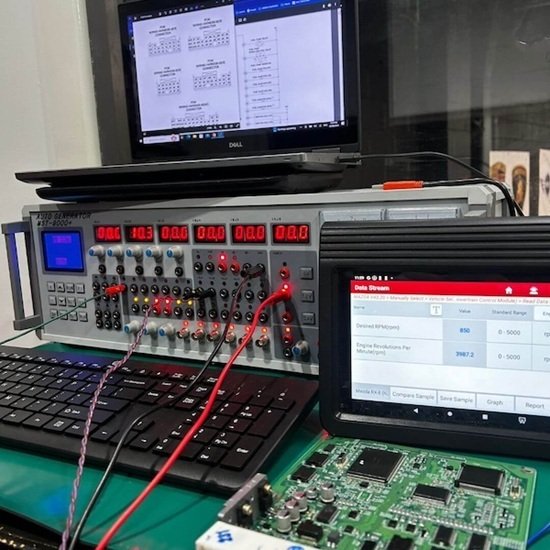


Our Automotive ECU Programming Services;–
Restoring the control unit program
Our database contains thousands of projects that can be used to restore the program in the event of standard loss or incorrect reading. Recovery can be based on a read file (when only a small area accessible for modification is updated) or the entire program (but this often requires additional work using a scanner).
In some cases, it is possible to work with binary files using identifiers:
Toyota – standard restoration is possible, as well as software replacement, if an SPD3 scanner is available for adapting the units;
Scania – it is possible to write the exact software or from the update list.
For Caterpillar , we can work with FLS/FL2 files for the CAT ET scanner, including modifications that disable the DOC / DPF / EGR / SCR / TVA systems. Generation A6 units often require a patch for recording the modification using a scanner.
Cummins units for a number of manufacturers can be rewritten in xCal format for the Calterm scanner, which can read / read CS / rewrite control units. These units are common among more than a dozen equipment manufacturers.
We save your money
How to save on car maintenance? According to our statistics, half of all cars begin to gradually show faults in various systems within the first 3-5 years (or 60-100,000 kilometers). While it’s fine if it’s just a “Check Engine” light, often a limp-home mode is activated with limited power, and in some cases, the odometer even starts running until the engine shuts off.
The answer is obvious: such problems require prompt repair at the initial stages, as they can cause even more problems later.
Below, we provide an approximate cost estimate for repairing these systems for VW-Audi, BMW, Mercedes, and Land Rover engines. If you don’t have time to read, we’ll just summarize: it ‘s much cheaper and more reliable to disable the offending system than to repair it and have the problem reoccur . Considering that for a nominal additional fee, you can install a tuning program and disable a couple more systems, it becomes clear that repairing all systems would cost more than 10 times more !
And that’s not even counting the fact that you can install an economy tuning option and spend less on fuel ! Or a factory-installed, higher-power engine if the engine is available in several variants. This can save you hundreds of thousands of rubles compared to buying such a variant from a dealer, not to mention lower vehicle taxes and insurance!
Diesel particulate filter and catalytic converter
Diesel vehicles meeting Euro 4 and higher emission standards are equipped with a diesel particulate filter (DPF), while all engines meeting Euro 3 and higher emission standards are equipped with a catalytic converter .
Diesel particulate filters (DPFs) with additional fuel injected downstream of the engine via a special injector are particularly susceptible to failure, with failures occurring as early as 50,000 kilometers (Ford, SsangYong, Renault, and Peugeot). Slightly better statistics apply to models with additional fuel injected through the engine (BMW, VAG, Mercedes-Benz, Kia, and Hyundai). These vehicles can develop problems after 100,000 kilometers, even if the monitoring sensors (temperature and exhaust differential pressure) are functioning properly. However, problems can occur even earlier if these sensors fail for the first time.
Typically, the problem is progressive, and the filter’s performance becomes increasingly limited, resulting in increased fuel consumption and poor performance (due to both reduced engine efficiency and the activation of emergency mode). If you have both a diesel particulate filter and a catalytic converter, you can remove only the former, leaving the latter to treat the gases for the same mileage.
So, the problem is clear, let’s calculate the possible investments in repairing the system and its sensors in the event of a failure in a 4-cylinder engine (of course, for a 6-cylinder engine it will be even more expensive) as of the end of 2020.
Volkswagen Passat / Audi A4 2.0TDI 2012+ – a diesel particulate filter in the VAG 8K0254750NX will cost around 150,000 rubles, similar JMJ JMJ1013 ones from 25,000. The VAG 03L906088E temperature sensor is around 7 thousand rubles, and the differential pressure sensor is a few thousand more.
For a similar gasoline turbo engine, the VAG 8K0254253FX catalytic converter will cost from 90 thousand rubles. A VAG 03L906262 lambda probe costs 10,000 rubles; similar units can be found for half the price.
Without going into detail, prices for 3.0L engines will be 20-25% higher.
For a BMW F15 3.0TDI 2012+, the 18308572808 diesel particulate filter starts at 130,000 rubles, and a sensor kit costs around 20. For a gasoline engine, three catalytic converters are installed on each section of the Y-pipe, and the primary 18307805780 alone will cost 90,000 rubles, with the two subsequent ones costing about the same.
Servicing the Mercedes GL 350cdi Blue Tec diesel particulate filter system is also quite expensive. The filter itself A1644906292 is 120-150 thousand rubles, the catalytic converter A1644905114165 is 1 thousand rubles. Sensors: backpressure A0091535028 is about 4 thousand rubles, temperature A0009055105 is 8 thousand rubles (in addition to it, two more are installed – 5 and 2 thousand rubles).
Parts for repairing Range Rover Evoque 2.2 TDCI : diesel particulate filter LR068415 from 63 thousand rubles, and sensors LR 001370 is 14 thousand rubles, LR 015455 is 6 thousand rubles and LR 005499 is about 5 thousand rubles.
Gas circulation – EGR, SAI, EVAP and swirl flaps
These systems are found in many cars, both petrol and diesel.
For a VAG 2.0TDI 2012+, the 03L131501K EGR valve will cost around 15,000 rubles, with similar models starting from 10,000 rubles. The 03L128063AF throttle valve, which is almost always open on a diesel engine and also plays an auxiliary role, costs about the same. The VAG 079959231
secondary air pump starts at 17,000 rubles (similar models start from 10,000 rubles), and the VAG 06E131101D valve is another 5,000–8,000 rubles.
For a BMW F15 3.0TDI 2012+, the EGR valve (11717810871) will cost around 13,000 rubles. (replacements from 7), electromagnetic (11747810831) and vacuum correctors (11 71 8 511 638) – 2 thousand rubles each, damper 11618570791 from 15 thousand rubles, for the swirl flap system 11617811909 Intake manifold with control – 65 thousand rubles.
Repair of EGR Mercedes GL 350cdi BlueTec includes several parts as they fail: recirculation valve A6421401860 33-44 thousand rubles (analogues from 20), heat exchanger A6421401875 – 32 thousand rubles, damper A6421500494 about 10 thousand rubles.
EGR system for Range Rover Evoque 2.2TDCI – LR000997 valve itself from 22,000 rubles, LR017782 vacuum valve about 4,000 rubles, LR 022354 cooler from 38,000 rubles.
AdBlue and SCR urea injection systems
Euro 5+ vehicles are equipped with an additional urea injection system for additional gas neutralization—SCR, AdBlue, BlueTec, BlueMotion. It’s a good idea, reducing fuel consumption by about 3%, but it can be finicky to operate, and if it fails, it often starts counting down the mileage until the engine is turned off. Yes, no matter where you are or what you’re doing—the system will simply shut off the car and wait for it to fully recover! This can seriously complicate the operation of such a vehicle.
For a Volkswagen Audi 3.0 TDI, AdBlue system repair (with a tank for the reducing agent) starts at 40,000 rubles (8K0 131 878 H). If you buy the parts separately, it will be even more expensive: VAG 8K0 131 984 C Dosing line to the reducing agent injector from 12 thousand rubles, pump 8K0131899K from 50 thousand rubles, injector for injecting reducing agent 3C0131113C – from 14 thousand rubles. You can
repair the SCR system on a BMW F15 3.0TDI 2012+ using a set of parts: injection metering unit 18308514448 will cost from 15 thousand rubles, tubes from the tank 1619729566310 thousand rubles, SCR control unit 61357394466 from 33 thousand rubles, additive supply pump 16197351665 will cost 55 thousand rubles, and the tank with sensors 16197295653 – 50 thousand rubles .
Troubleshooting the urea system of the Mercedes GL 350cdi BlueTec includes a number of parts. And in case of serious breakdowns, it is necessary to first stop the counters before stopping the engine (including replacing broken parts), and only then disconnect the system. The A1644707301 additive tank costs from 108 thousand rubles, the A0024706894 pump from 55 thousand rubles, the A1644711275 heater from 46 thousand rubles, the A1644900513 additive injection nozzle from 25 thousand rubles.
Power graphs
The engine control unit processes hundreds of parameters that affect the final power of the internal combustion engine. Our work involves carefully analyzing and modifying engine operating algorithms within the acceptable service life, changing key aspects, and further refining them based on customer feedback.
Our network has everything necessary for expert modification of control programs . We use our unique development, which reproduces the unit’s logic and identifies bottlenecks that limit performance at the desired level. As a result, a graph of the standard and optimized program is created, with only key adjustments required to achieve the desired result. Essentially, our approach is an extension of the engine engineers’ logic, which can also be achieved by installing a more powerful factory program.
This section presents some power graphs after chip tuning , clearly demonstrating the results of this entire process.
Because not only the increase in power is important, but also the operating range. For example, the Mercedes lineup includes a 2.2-liter 250 CDI engine with declared parameters almost identical to those of a 3-liter engine. The graphs show that the engine delivers maximum torque as a narrow peak, while the 3-liter engines deliver this figure as a wider bar. In the former case, the increase will primarily be due to a wider peak torque with relatively small increases in maximum values, while the 3-liter version will have a higher bar, both in the figures themselves and in the graph appearance.
Also note that the engine specifications may differ from the examples provided , as different versions of standard programs may vary in power, and the final result at the wheels depends on the vehicle’s condition and the percentage of losses in the transmission (10-20%). In this case, the relative figures showing the torque changes after chip tuning come first .
If the graph you need is not listed, look at similar engines by volume and power, as well as in other brands of the concern (VAG – VW / Audi / Porsche / Skoda / Seat; Renault – Nissan; Peugeot – Citroen, etc.).
Removing the catalyst
A catalytic converter is an essential part of a modern car. With its porous structure and large contact area with exhaust gases, it burns unburned exhaust gases into less harmful compounds. Containing rather expensive metals, a new catalytic converter can cost around a thousand dollars… and a car may have up to four of these components.
Over time, a catalytic converter can fail. Early on, the Check Engine light appears, followed by poor performance and increased fuel consumption. A buildup of oxidation products reduces the catalytic converter’s capacity, increasing the flow rate and temperature of the exhaust gases. Eventually, the catalytic converter begins to deteriorate , and fragments can clog the porous structure of both the converter itself and subsequent converters, or even the muffler. All this significantly impairs engine performance and can even render the vehicle unusable.
In this situation, it is necessary to either replace the catalytic converter or remove it and convert it to Euro 2 emissions .
Important! All vehicles with an active Check Engine light must be diagnosed before any further work is performed!
All faults in other systems are repairable and can cause a malfunction even if our services are performed correctly .
Fake oxygen sensor or Euro-2 program
A second oxygen sensor dummy is the cheapest solution, but it’s neither particularly reliable nor complete. Firstly, it may require repeated calibration, and without precise tuning, the car will continue to display the Check Engine light with codes related to the catalytic converter. Secondly, it requires a working oxygen sensor, which also needs to be replaced if it fails.
The Euro-2 program is somewhat more expensive, but this is only at first glance. Firstly, you can disable or physically remove the second oxygen sensors after the catalytic converter. Secondly, the program guarantees proper operation; the car won’t display the Check Engine light for the catalytic converters and their sensors or go into emergency mode with increased fuel consumption. And thirdly, it gives you peace of mind during pre-sale preparation of the car, when any such issues can affect the price or even discourage the buyer.
Catalytic converter disabling costs start at 70% of the price of chip tuning services, based on catalogs for passenger cars and commercial vehicles .
Remove the diesel particulate filter
If the diesel particulate filter (DPF – Diesel particulate filter / FAP – Filter Additive Particulate) becomes heavily clogged and fails, power drops, fuel consumption increases, and the Check Engine light comes on. There are two options: either replace the expensive spare part or remove the diesel particulate filter from both the software and the exhaust system. The second solution is several times cheaper, but first requires a high-quality software update. Often, proper operation is guaranteed with all working and connected sensors , even despite software disabling or emulation. Only in some cases does the mechanical component also need to be disconnected from the differential pressure and/or exhaust temperature sensor connectors.
Another option for our customers is software emulation of a working diesel particulate filter . This involves modifying the operating code so that any readings from the sensors monitoring the diesel particulate filter are perceived as normal and will not lead to errors or regeneration. This primarily involves emulating the operation of the differential pressure and exhaust temperature sensors.
Attention! All vehicles with an active Check Engine light must undergo a diagnostic before any further work is performed! All other system malfunctions are repairable and can cause a limp mode even if our services are performed correctly . Unless otherwise stated, after mechanical removal, all sensors should be left in place, and the integrity of the wiring and the proper flow of all tubular connections should be checked.
Software deactivation of the diesel particulate filter and mechanical removal
A software solution for diesel particulate filters is always combined with mechanical intervention; otherwise, the porous elements will continue to accumulate deposits, leading to the same problems. We support virtually all vehicles, and pricing can be calculated by clicking on any line in the passenger car and heavy equipment catalog .
Our solutions include the most common codes and also take into account all current diagnostic faults, without affecting other systems beyond the scope of the intervention. Therefore, comprehensive diagnostics are possible in the future should any faults arise, and if an unusual code is detected in a system that has already been disabled, updates are available under the warranty certificate .
The cost of disabling a diesel particulate filter starts at 80% of the price of chip tuning services, according to chip tuning catalogs for passenger cars or commercial vehicles .
Urea shutdown
Euro 5-6 vehicles are equipped with a urea injection system, designed primarily to reduce nitrogen oxide emissions. However, despite its simple design, the system consists of fairly large components and is difficult to repair, so replacing one component often necessitates several adjacent components. At low temperatures, the level sensors or additive pump quickly fail, and the car begins counting down the mileage until a scheduled engine shutdown, which essentially compromises its functionality.
We offer a comprehensive AdBlue system removal service , which allows us to remove any system component—from the fuse to the urea controller in the electrical system and from the pump to the injector and sensor in the mechanical system. The minimum amount of work, other than the urea deactivation program itself , is to disconnect the connector from the controller or remove its fuse.
The most common examples among passenger cars are European cars of 2010+ with Bosch EDC17/MD1 controllers: Audi Q7 3.0TDI ; BMW X5 E7x 3.0TDI ; Mercedes BlueTEC 2.0-3.0TDI ML 350CDI , GL 350CDI , GLS 350CDI , GLE 350CDI , GLK 220CDI , GLC 200-220CDI , Vito 250CDI ; VW rafter 2.5TDI .
Among cars developed in Asian countries, the urea injection system has been found under the control of Denso units since about 2015: Mazda Cx-7 2.2TDCi ; Hyundai H1 2.5TDI 2017+ .
Buy a urea emulator or disable the AdBlue system?
Urea injection systems are widely used in trucks, tractors, and other road construction equipment, and are combined with a DOC (Diesel Oxidation Converter) filter, which functions as a catalytic converter. Urea injection system emulators , which replace key operating parameters with normal ones, are also widely used. However, they only partially resolve issues with a generally functioning system, replacing only the key sensors. They cannot completely replace the system, alter power output, or disable other faults or systems ( DPF , crankcase gas recirculation, or EGR ). Cheap emulators can also fail at any time after a certain period of use, and replacement requires paying the full cost of the emulator, waiting for delivery, and specialist installation.
Therefore, disabling urea in the engine control unit with a warranty of up to 10 years , although somewhat more expensive initially, is a more reliable solution. The potential for increased power or the need for repairs to other systems ultimately outweighs the cost of a high-quality program.
Malfunctions of the urea injection system occur in almost any modern equipment – both domestic and foreign origin.
Mitsubishi Fuso Canter 3.0TDI – EDC17CP52.
Kamaz / Nefaz / KRAZ with engines 6.7 TDI Cummins CM2150-2880, 11.7TDI Bosch EDC7.
MAZ with engines 11.6TDI WP12.430 EDC17CV44.
Foton Auman 10.0-12.0TDI 2014+ EDC17CV44
MAN TG -A,S,L 10.5TDI 2011+
Iveco Stralis 8.0-10.3TDI 2009+
Volvo Volvo 12.8TDI 2008+
Hino 300-700 with engines 4.9-12.9TDI.
As well as tractors and construction equipment – Caterpillar , JCB , John Deere , CLAAS and many others .
Important! All vehicles with an active Check Engine light must undergo diagnostics before any further work is performed!
All faults in other systems are repairable and can independently trigger the emergency mode, regardless of other shutdowns .
The price for AdBlue urea deactivation starts at 85% of the price of chip tuning services according to the catalog for chip tuning passenger cars and commercial vehicles .
EGR (gas recirculation system) removal
Exhaust gas recirculation (EGR) is the most common failure of exhaust gas recirculation systems (or AGR in German). The EGR valve returns heated gases from the exhaust system to the intake manifold. Its primary purpose is to increase the temperature of the gas mixture entering the engine, which reduces the formation of various nitrogen oxides. However, over time, soot particles accumulate in the intake manifold, and the air flow sensors or the valve itself may become inoperative. This leads to diagnostic errors and the vehicle entering emergency mode. Bosch control units can perform this entirely programmatically— disabling the EGR valve without mechanical intervention , meaning there’s no need to even mechanically shut off recirculation. In other cases, it’s only possible to shut off recirculation to zero , while the valve’s clearance is still mechanically closed. A third option is to disconnect the EGR connector , leaving the valve simply closed. This method is available on all types of ECUs and also requires a proper software update.
Removing swirl flaps
Intake manifold swirl flaps (or IMRCs – Intake Manifold Runner Controllers) help distribute the gas flow for optimal combustion. This is common in diesel engines, and is also common in gasoline engines—for example, in the VAG series of FSI (Fuel Stratified Injection) engines and turbocharged versions of TFSI/TSI engines. Overall, the system slightly improves the engine’s environmental friendliness and fuel efficiency, but not so significantly that it requires replacing an expensive part if it fails. This is most often seen in diesel engines when a certain amount of soot from the exhaust gas recirculation system ends up in the intake.
When the IMRCs become stuck closed, the intake system’s flow capacity is insufficient—the car produces increased smoke and loses some power. The Check Engine light comes on on the dashboard, and the car may go into limp mode.
Naturally, the most reliable option is to remove the IMRCs and disassemble the intake manifold. There are quick, temporary fixes that can lock the swirl flaps open without disassembling them. This involves removing the actuators and locking them open from the outside (their operation is visible under the hood when the ignition is turned on). However, this doesn’t guarantee a solution, as over time, the plastic flaps can disintegrate and fall into the engine. Therefore, we offer only a complete solution: removing the swirl flaps from the intake manifold and updating the engine software to ensure proper operation in this mode.
Disabling secondary air, adsorbed and crankcase ventilation.
The Secondary Air Injection (SAI) system is activated when the engine is cold and forces atmospheric air into the exhaust tract behind the exhaust valves for 1-2 minutes. This oxygenates the exhaust gases, initiates afterburning, and accelerates catalytic converter heating. The engine control unit controls the SAI system via the secondary air pump relay and air valves. With each subsequent engine start, the SAI system is activated at idle for 10 seconds.
If the system malfunctions, the cost of repair can significantly exceed the estimated benefit, so troubleshooting secondary air injection errors is often necessary . No mechanical intervention is required; a plug can be installed over the pump or valve clearance, if desired.
The crankcase ventilation system is designed to reduce fuel vapor emissions into the atmosphere. Crankcase ventilation in naturally aspirated engines is achieved by creating a vacuum in the intake manifold, while in turbocharged engines it is achieved through throttle control. If the system malfunctions, no significant operational changes may be noticed, only a malfunction indicator lamp. The output of specific codes in the alert can be disabled through a software update without any mechanical intervention.
There’s also a system for removing excess gases from the fuel tank, equipped with a catching element called an adsorbed. Like any filter element, it can fail and require repair. If repair is difficult, you can also remove the absorber and disable the specific codes for this system.
Important! All vehicles with an active Check Engine light must undergo diagnostics before any further work is performed!
All faults in other systems are repairable and can independently trigger the emergency mode, regardless of other shutdowns .
The cost of disabling the EGR or swirl flaps starts at 70% of the price of chip tuning services according to chip tuning catalogs for passenger cars or commercial vehicles .
Diagnostics and decoding of errors via the OBD2 port.
All our locations are equipped with scanners for diagnostics and decoding error codes via the OBD2 diagnostic port . The port itself is universal for all vehicles and is typically located near the steering wheel, often underneath it.
If the Check Engine icon is present on the dashboard, other work can be performed primarily after the vehicle has been repaired, or if the tuning program includes troubleshooting solutions (converting to Euro 2, disabling the diesel particulate filter or EGR system).
However, troubleshooting may require a specialized scanner for a specific vehicle brand (VW-Audi-Seat-Skoda, BMW-Mini, Peugeot-Citroen, Fiat-Alfa-Lancia, etc). For in-depth diagnostics for various vehicle brands, please contact our regional centers.
If any faults are detected, chip tuning services are provided only for isolated errors that can be corrected by reprogramming the ECU (catalytic converter, diesel particulate filter, EGR system, or AdBlue injection system). If other faults are detected, chip tuning is only possible with the owner’s consent to the contractor’s limited liability for these systems (including all adjustments and warranty work). Service providers are not responsible for correcting other vehicle faults or their negative impact on vehicle performance, either before or after our work.
Selective error disabling
A standard vehicle is factory-configured with self-diagnostics for all systems, displaying results both on the instrument cluster and in detailed form using specialized scanners. However, during vehicle operation (or modification), it may be necessary to disable certain components. In addition to common problems with the catalytic converter and diesel particulate filter , there may be more specific issues that not everyone can resolve. For example, removing the intake manifold swirl flaps, disconnecting the secondary air system, or disabling the urea injection system (AdBlue/SCR ). Other options include removing the aforementioned systems by disabling individual sensors, or clearing errors related to lambda probe or injector heating. It’s crucial not only to remove interfering errors but also to maintain the full diagnostic coverage of all other issues.
Not all companies claiming to downgrade to Euro 2 or 3 are capable of providing this level of service. Often, a cheap solution is to disable almost all errors, which impairs diagnostics of any future faults. Our solutions stand out because they accurately decode errors and disable only a few interfering codes , without affecting other vehicle systems. Beware of cheap and low-quality offers that limit your future diagnostic and repair capabilities!
We’ve now decoded the operating algorithms for the most common control units and regularly use them in everyday operations.
Commercial transport
Work vehicles also require maintenance – minibuses, Category B utility vehicles, forklifts, tractor-trailers, semi-trailers, trucks, and buses . They have the same wide range of options for tuning the internal combustion engine and disabling eco-systems as regular passenger cars. Tuning programs prioritize not power output, but good torque combined with engine efficiency , the durability of internal combustion engine components, the reliability of solutions, and trouble-free operation. Removing expensive systems, such as the diesel particulate filter (DPF) , urea injection , and disabling exhaust gas circulation systems (EGR, swirl flaps, secondary air, or crankcase ventilation) , also plays a significant role .
Our catalog already includes examples of Eco-tuning , where even the basic version emphasizes fuel efficiency, and then, secondarily, increases power under load – when the driver presses the pedal more or drives loaded uphill. And what’s important is that it’s often possible to have your equipment serviced promptly, with return to operation within 24 hours of your request.
The passenger car catalog features medium-weight vehicles.
The Citroen Jumper / Citroen Jumpy,
the Ford Torneo / Transit is one of the most popular models
, the Fiat Ducato
, the Mercedes Sprinter / Vito / Viano / Vaneo,
the Volkswagen Caravelle / Crafter / Transporter,
and heavier vehicles like the Mtsubishi Fuso Canter
and many others.
Disabling urea and EGR on trucks
Trucks, tractors, and special equipment are also presented in a separate cargo catalog on our website. Often, one of the elements of the urea injection system (AdBlue, SCR), the DPF / DOC (Diesel Oxidation Converter) particulate filter, or the EGR gas recirculation system fails.
DAF – 3.9-12.9 TDI Delphi DMCI, ECSDC3, Bosch EDC7 – disabling urea, EGR, and particulate filter.
Isuzu – Elf, NPR, and Forward with 3.0-7.2 TDI engines – tuning programs to increase power and efficiency; disabling the particulate filter, EGR gas recirculation, and other auxiliary systems (Transtron control units).
Iveco – Stralis 10.3TDI – deleting DPF, EGR, SCR (Bosch EDC7), Daily 3.0 TDI (EDC17CP52).
MAN – 2009+ TG-S, TG-L, TG-A – also available eco-tuning, disabling the particulate filter, EGR system and urea injection (based on Bosch EDC7C / C32, EDC17CV42).
Renault – DXi5-7-11-12-12 engine line – disabling urea, particulate filter and EGR (TRW EMS2).
Scania – almost all diesel engines controlled by EMS S6 / S7 / S8 and EMD1 units.
Volvo – FH / FM13 12.8 TDI – disabling urea, particulate filter and EGR (TRW EMS 2.0-2.2a).
For domestic manufacturers, solutions for all major types of equipment have also been tested.
KAMAZ (NEFAZ, KRAZ) with 6.7-11.7 TDI diesel engines – removal of urea injection and other eco-systems on the Cummins and Bosch control units. Sensor removal is possible, as well as the installation of eco-tuning programs.
MAZ with 6.7 TDI diesel engines – DPF and EGR removal on the Bosch EDC7 control unit and WeiChai 11.6 TDI WP12 EDC17CV44. Urea and EGR removal and the installation of any tuning programs are possible.
GAZ – with 2.8 TDI diesel engines with CM222x units, 4.4 TDI on the Bosch EDC17CV44 control unit, as well as our unique development for 4.4 CNG methane engines with WestPort WP580 control units , allowing for tuning and disabling the EGR / E2. Among heavy equipment, software solutions for tuning and disabling eco-systems for Caterpillar , John Deere , JCB , and Claas
are also in demand .
The price for DPF/EGR/SCR deactivation can be calculated by clicking on any line in our catalog. Mechanical work is arranged separately, and a discount of up to 20% is available for on-site ceramic recycling.
Stage 2 ECU Tuning
Our catalog is increasingly featuring additional options for boosting certain vehicles – Stage 2 tuning for Audi/VW/Skoda, BMW, Mazda, Mercedes, Volvo, Toyota, Lexus, and other brands. Compared to standard solutions, the second stage of power enhancement offers an additional horsepower boost and can include the ability to disable the catalytic converter or diesel particulate filter. Turbocharged and turbo diesel engines with a good safety margin, or those derated from the factory, allow you to unlock the engine’s potential at this level. The changes only affect the power range, so at average driving speeds, average fuel consumption remains unchanged.
Compensation for losses for a derated engine
A fairly common option for expanding the engine range is when a single engine is produced in several versions with different power outputs. In this case, it would be quite natural for the first stage of modification to be up to a more powerful factory version, and the second stage would be forcing a relatively new level. Moreover, as for the first stage, the average consumption or engine life remains at the same level, since the operating time in the increased power range is no more than 5%.
In addition to tuning programs, you can order the installation of a more powerful factory program in our catalog .
For naturally aspirated gasoline engines, there are many examples where the differences between different versions reach 40 hp. For example, in the Toyota model range, there is a 2.7 liter engine with a capacity of 150 / 157 / 163 / 185 hp; 3.5 liters – 249 / 273 hp; 4.6 liters – 309 / 318 hp. Such examples even exist among 1.6-liter engines—for example, the Ford Focus 100-125 hp, and the Skoda Octavia 90-110 hp.
For turbocharged engines, power is directly related to turbine efficiency , so this issue is quite easily adjusted in software. This issue is most clearly illustrated by compressor maps of individual turbines, where the most efficient operating zones are marked depending on pressure and air flow. Operation on the left side of the graph is dangerous due to turbine stalling or impeller reverse rotation, when the gas flow in the hot section of the turbine is insufficient to rotate the second impeller. The right side of the graph, however, reaches a zone where the impeller speed reaches the speed of sound, and the turbine loses the ability to pump even more air.
As can be seen from the examples below, standard turbine operating modes not only have a good reserve in the midrange, but also often “dips” between the main peaks, where the maximum rated values for torque and power are recorded. All of this is taken into account and compensated for in our tuning programs, and sometimes it is possible to achieve noticeable results even without a significant increase in maximum power (optimization of the program in the mid-range of revolutions).
VW-Audi Stage 2
1.2 TSI 85 / 105 hp
1.4 TSI with one turbo 122 – 140 hp and supercharged 150-180
hp 1.8 Turbo 150 / 170 / 180 hp
1.8 TSI 120 / 152 / 160 hp
2.0 TFSI 170 / 180 / 200 / 211 hp
3.0 TDI 204 / 224 / 233 / 240 / 245 hp
Porsche Cayenne Turbo / Turbo S: 4.5T 450-500 hp, 4.8T 500-550 hp
On the right is a map of the most common turbocharger for the VW-Audi group – the Borg Warner (KKK) K03, which has been used for over 10 years in both mono- and bi-turbo (6-cylinder) versions. A quick inspection reveals that even the standard variants extend beyond the right border of the map, which is why the same border is used in tuning variants.
The weakest version of the 1.8T produces 120 hp, which becomes practically naturally aspirated by 5,000 rpm. The same trend is visible for the 2.0T (170 hp): after the peak in the area of maximum torque, boost quickly decreases and demonstrates relatively low power at 5,000-6,000 rpm, where the 200-211 hp versions boost by 0.2-0.3 bar (there are even more powerful 225 hp versions of the 1.8T, but they come with a more efficient turbocharger). In fact, the standard tuning option for full-power versions will be Stage 2 or even 3 for less powerful engines .
BMW Stage 2
2.0 TDi – in versions 18d 150hp 320Nm, 20d 177-184-190hp 280-400Nm, 23d 204hp 400Nm, 25d 218hp 450Nm.
3.0 TDi with one turbine is installed in different bodies with indexes 25d-30d and produces 204 / 218 / 235 / 245 / 258 hp and a torque of 450-560 Nm
3.0 sDi 286 / 306 hp
3.0T N54 135 306 hp / M1 320 hp
4.4T X6-M with factory settings of up to 1.2 bar (550 hp) and M5/M6 at 1.5 bar (according to the data sheet, it’s 5 hp more powerful, but in reality, the difference is an order of magnitude greater). Therefore, Stage 1 for the X5-X6, despite the similarity in data sheet values, will not actually be that much more powerful than the standard M5 F10 turbo, and the tuned version of the latter is, in turn, like Stage 2 for the SUV class.
Mercedes-Benz Stage-2
2.2 CDI has the widest range, engines of recent years from 85 to 170 hp. The latest models, of course, come with different turbines, but with a step of 30-70 hp. the engines will be the same, including basic software settings, and the differences are often only in the limiting values (torque, fuel injection).
3.0 CDI with a capacity of 190 / 224 / 231 / 235 / 258 hp.
The 2.0 Turbo series of engines with a capacity of 156 / 180 / 204 / 211 hp – available for tuning since autumn 2015!
Volvo D5 Stage-2
Five-cylinder 2.4 TDI engine with a capacity of 163 / 175 / 204 / 215 / 235 hp.
It is installed on the entire range of body styles – S60 / XC60 / V70 / XC70 / XC90, etc. Almost everywhere it produces a torque of 400-420 Nm, but the power is electronically limited at varying levels. In the weakest version, boost at peak torque (2200 rpm) can reach 1.4 bar, but with revs it continues to increase only on more powerful engines – to 1.5-1.6 bar, and then decreases. And this despite the fact that for a turbocharger, a pressure of 1.8 bar up to 4 thousand rpm is quite normal , and at low revs there is still a good reserve even after the standard Stage 1 of full-power engines (also known as Stage-2 for derated versions).
Toyota Stage-2
The model range includes full-power and derated engines.
Rav4 2.2 TDI 150 / 175 hp.
Hilux 2.5 TDI 100/125/140 hp.
Prado 3.0 TDI 131/163/173/190 hp – turbocharged engines are listed, as less powerful naturally aspirated diesels are also available.
Land Cruiser 200 4.5 TDI 204/235/265/286 hp.
Second stage of boosting engines with a long service life
This approach is primarily applicable to vehicles where the turbo’ s performance allows it to operate at higher pressures without significant impact —and thus realize the potential for even greater fuel consumption. This is most clearly demonstrated by the compressor maps of the most popular 1.8T variants—even a cursory inspection reveals significant potential for increased pressure in the mid-range. This explains why diesel turbos operate at higher pressures, as they don’t have as wide a range of revs as gasoline engines, where such operation is complicated by the need for even more careful exhaust temperature and detonation control.
On the right, we see a compressor map for a BMW N54 3.0 Twin Turbo engine , designed for a single turbo and a displacement of 1.5 liters. This engine is known both for its potential and for its frequent failures of the high-pressure fuel pump, which is perhaps the most common limiting factor. As you can see, the standard utilizes only the turbo’ s base potential, and the standard boost curve, like most standard variants, features a slight dip in the center between the torque and power peaks. Manufacturers are guided by other factors (emissions, heat output, or fuel efficiency). As you can see, for this engine, the maps allow for up to 1.4 bar of boost up to 4,500 rpm, which is almost 0.2 bar higher than the Stage 2 recommendation. The next-generation N55 Twin Power engine
is also performing well, but favors torque: the BorgWarner twin-scroll turbo spools faster and more easily, delivering more torque earlier. It also maintains up to 1.2 bar of boost well in the midrange, but pressure has to be reduced more quickly with higher revs to avoid damaging the turbo and extend its life. Therefore, around 6,000 rpm, the figures are possible to be ~20-30 hp (up to 0.2 bar) lower than the N54. However, with better torque, this does not make the car noticeably slower than its predecessor, and also allows for earlier shifting (up to 6 thousand rpm) and faster reaching gears with maximum boost.
Other examples for this section are given below.
BMW 3.0 TDI, SDI / 3.0 Turbo N54-55.
VAG, MB 3.0 CDI.
Mitsubishi 2.0 Turbo.
VAG 2.0 TFSI / TSI.
VAG 2.7 Turbo K04-2275.
Mazda 2.3 Turbo K04-2280.
The last two variants on the BorgWarner K04 turbo are shown in the graphs on the right. However, despite the similarity of the name, the K04-2275 turbo version for Audi is 20% weaker than the 2280 for Mazda. However, based on 1.35 liters per turbo, it looks quite good – Stage-2 allows maintaining up to 1.5 bar throughout the entire range, only decreasing to 1.4 bar at the cutoff with a peak load of 0.18 m3/s.
For the Mazda 2.3T, a more efficient turbine allows maintaining 1.3 bar up to 5,500 thousand revolutions (0.22 m3/s), reducing the cutoff almost to the first stage indicators.
Tuning program for mechanical modifications of the car.
Further stages of power enhancement, which combine chip tuning with mechanical modifications, are also worth noting . The first steps include installing high-flow intake/exhaust systems with minimal resistance, tuning compressor/crankshaft pulleys, or higher-performance turbo and fuel pumps. Fine-tuning to customer requirements may require several iterations to optimize the program across all performance ranges and takes longer than standard service packages.
Economy tuning 2.0
Our service quality has always prioritized combined engine tuning options , which allow us to combine significant increases at full throttle and fuel economy at a leisurely pace within a single program.
Recently, options that maximize the engine’s fuel efficiency potential have become increasingly popular, so we’ve developed and tested new solutions in this area. After all, for greater performance, we always press the gas—and the engine produces more RPM and power. So why not make the lower RPM range even more fuel-efficient?
New-generation fuel-efficient programs offer half the torque increase, and power as RPM increases is almost the same as full-power versions! Therefore, we also offer combinations with increased torque increases, such as Stage-2 Eco. Our Economy Tuning line is in high demand among commercial vehicles.
Engine firmware for fuel economy
So, what distinguishes the new generation of economy versions from the standard tuning files on our network? A number of features allow for the best fuel economy results – approximately -2 liters versus -1 liter in the standard version under moderate driving conditions. That’s twice the fuel economy of the standard program!
The best results are naturally achieved on diesel engines, so graphs from two of the most popular 4-cylinder engines are provided as an example.
The torque peak has been shifted (not noticeable in practice).
The torque plateau is smoothed and builds up smoothly with revs.
Throttle adjustments are made at low revs and under load.
Ignition timing and fuel injection timing are optimized.
Excessive boost pressure is reduced (the greater the load on the turbine, the greater the exhaust resistance).
Excessive fuel enrichment is corrected to optimal values.
A significant increase with increasing revs significantly improves the vehicle’s performance. Economy tuning with us doesn’t mean less power! Under the hood, you’ll have even more potential than with the standard version.
Economy tuning options can also be combined with any type of deactivation. These programs are now available for order in our catalog, along with the standard versions. It’s worth noting that fuel consumption may also increase with dynamic driving; we’re simply creating the conditions for fuel savings where necessary. The rest is entirely up to you!
Automatic transmission chip tuning – DSG, CVT, S-Tronic
For VW-Audi vehicles with a DSG automatic transmission, we offer a comprehensive engine and automatic transmission tuning solution that will safely and efficiently utilize the vehicle’s potential.
What does tuning the automatic transmission control software offer ?
Two key benefits: faster gear shifts and increased torque from low revs. Petrol engines become more diesel-like in torque delivery! The car drives smoothly from 1,500 rpm, downshifts less frequently, and maintains momentum perfectly even with partial gas pedal application.
Our software also optimizes gear shift ranges, improves throttle response, and delivers noticeable results even without installing engine tuning software !
In addition to DSG , the following transmissions are also supported: VL380-381 CVTs, Aisin AL1000, DL382, ZF AL551-951 automatic transmissions (this model is also used on BMW as ZF8HP), Temic DL800 (including Lamborghini).
Tuning options for the VAG DSG DQ200/250/500
It’s no secret that a car’s potential is limited by software, both in terms of the engine and automatic transmission. It’s important to know what limits we can aim for when planning a tuning program. The table below shows that the dry-clutch version utilizes approximately 80% of the transmission’s potential, while the wet-clutch version utilizes only 60-70% or less!
| DSG type | Clutch type | Engine displacements | Moment, Nm | Cars |
| DSG7 0AM (DQ200) | dry | 1.2 -1.8 | 250 | Audi: A1, A3(8P – until 2013), TT; VW: Golf6, Jetta, Polo, Passat, Passat CC, Scirocco, Tourna, Ameo; Skoda: Octavia (1Z – until 2013), Yeti, Superb, Fabia, Roomster, Rapid; Seat: Altea, Leon (1P – until 2013), Toledo. |
| DSG7 0CW (DQ200) | dry | 1.2 – 1.8 | 250 | Audi: A3 (8V – from 2013), Q2; VW: Golf7, Passat (from 2015), Touran (from 2016); Skoda: Octavia (5E – from 2013), Rapid (diesel from 2013), Karoq; Seat: Leon (5F – since 2013). |
| DSG6 02E (DQ250) | wet | 1.4 – 3.2 | 350 | Audi: A3 (8P – until 2013), TT, Q3; VW: Golf, Passat, Touran, Scirocco, Sharan, Tiguan; Skoda: Octavia (1Z – until 2013), Yeti, Superb; Seat: Altea, Leon (1P – until 2013), Toledo, Alhambra. |
| DSG6 0D9 (DQ250) | wet | 1.4 – 2.0 | 350 | Audi: A3 (8V – from 2013), Q2; VW: Golf7, Passat (from 2015), Touran (from 2016); Skoda: Octavia (5E – from 2013), Rapid (diesel from 2013), Karoq; Seat: Leon (5F – since 2013); Seat: Ateca. |
| DSG7 0Cx (DL382-7F / 7Q) | wet | 1.4 – 3.0 | 400 | Audi: A4 / quattro (8W – from 2016), A6 (from 2011), A7 (from 2016), Q5 (from 2013). |
| DSG7 0GC (DQ381) | wet | 2.0 | 420 | Audi: A3 (from 2017), Q2; VW: Arteon, Golf (since 2017), Passat (since 2017); Skoda: Karoq; |
| DSG7 0B5 (DL501) | wet | 2.0 – 4.2 | 550 | Audi: A4 (until 2015), A5, A6, A7, Q5, RS4, RS5. |
| DSG7 0BT/0BH (DQ500) | wet | 2.0 – 2.5 | 600 | Audi: Q3, RS3, TTRS; VW: Transporter/Multivan/Caravelle, Tiguan. |
| DSG7 0DL (DQ500) | wet | 2.0 | 600 | VW: Arteon, Passat (since 2017), Tiguan (since 2016); Skoda: Kodiaq. |
The gearboxes for the legendary Porsche are also based on the DL501 DSG/S-tronic .
This unit now has a different name and an abbreviation derived from the German word PDK. However, it is still well optimized with high-quality updates to the gearbox logic, improving traction at low revs.
Since 2020, the PDK TC240 firmware has also been supported via the diagnostic port .
ZF transmission chip tuning – VW-Audi, BMW
The 8-speed BMW ZF8HP gearbox is supported , which has been widely installed on most cars of the Bavarian concern since 2013, and is also in demand among other manufacturers.
BMW 1 Series (F20, F20 LCI)
BMW 2 Series M235i-M240i (F22)
BMW 3 Series (F30, F30 LCI)
BMW 5 Series (F10/F11/F90, G30/G31)
BMW 7 Series (G11/12)
BMW X3 (F25), X3 20d/30d/30i/M40i (G01)
BMW X4 (F26)
BMW X5 35i (E70)
BMW X5 (F15), BMW X5 M (F85)
BMW X6 (F16), BMW X6 M (F86)
Other cars also use this excellent automatic transmission and can be tuned.
Chrysler 300 V6, 300 C
Dodge Charger V6, Durango V6 (2014-2017,2017+), RAM 1500 V6 (2013-19,2019+)
Jaguar XE
Lancia Thema V6
Volkswagen Amarok
Alfa Romeo Giulia / Quadrifoglio, Stelvio / Quadrifoglio
Jeep Wrangler/Wrangler Unlimited (JL)
Audi A4 (B8.5), Audi A6 (C7), A8/L (D4), Q5, Q7
Tuning automatic transmissions for other brands – Toyota, Ford, Renault, Mitsubishi
These brands have recently become supported for automatic transmission reprogramming, but are already rapidly gaining momentum for gearbox program tuning .
For some Toyota automatic transmission models , program optimization is available for generation 1 (76F0038/39/40/50/70/85 Gearbox CAN-bus) and 2 (76F0199 Gearbox P5-CAN-bus) with noticeable improvements in traction in the low and mid-range revs.
For Mitsubishi, these are CVTs on Lancer X/ASX 1.8-2.0, Outlander XL 2.0-2.4-3.0 (MH8104F/512KB MH8106F/1MB); and automatic transmissions Pajero Sport (2010+), Lancer X 1.5/1.6L (MH8102F/512KB).
For Renault, this is the DC4 automatic transmission, and for Ford, the most popular Focus 3 models: 1.6-2.0 with Power Shift 6DCT250 / 6DCT450 gearboxes.
Hidden chip tuning
Covert tuning of new cars while maintaining the dealer warranty is a complex task, with several possible solutions depending on the vehicle.
1. The dealer scanner verifies the originality of the program only by a special verification number (CVN). In this case, virtually any program changes are concealed if they are saved with the CVN and operate without errors. This option is suitable for vehicles manufactured in America, Japan, Korea, and China. If information about the counters and the time the program was written is available (on Bosch controllers and similar models), it is advisable to perform the work by removing the unit or on the same day as the authorized dealer visit.
2. The engine has maximum power from the factory , and dealer scanners verify the originality of the program not only by the specific signature and background diagnostic codes, but also by the maximum boost, torque, and speed values in the control unit operation logs. This most complex case is widespread in the German auto industry, which somewhat limits options during warranty service. There is a solution: flash the ECU in boot mode to increase power only, without changing the maximum torque, boost pressure, or speed limits. We offer the option to upgrade to any other program within our extended warranty . The counters and recording time will remain unchanged, and torque transfer can be optimized by flashing the automatic transmission control unit .
An alternative option is being tested : resetting all memory frames and ECU logs before visiting the dealer, which requires one of the simple scanners for servicing the vehicle.
3. The engine is available in several power ratings , switching between which does not introduce abnormal operating conditions, and testing with a dealer scanner will confirm the program matches one of the factory programs. This option is suitable for all vehicles with reduced power, but if information about the counters and program recording time is available, it is better to perform the work by removing the ECU or on the day of the appointment with an authorized dealer.
A slightly different type of tuning is the hardware-based option for changing operating modes from the car’s dashboard – economy / comfort / dynamic. In this case, based on one of the same options, you can change only the sport mode without touching all the others.
We’ll discuss the third option in more detail.
It’s no secret that many cars come with the same engines from the factory, but with different power ratings . This is the easiest way to expand the engine range—developing one engine and tuning it to the desired level using software, rather than creating several different engines. The difference between versions can be around 40-50, or even over 100 horsepower! These factory configurations are offered for a significant premium, while even dealers themselves offer upgrades at a fraction of the cost. Our database contains hundreds of such projects that allow you to flash a car with more powerful factory software . These will simply be changes to the original software in key areas, while preserving the original unit numbers.
Furthermore, this will allow you to save money on your car purchase ! By choosing an engine with a reduced power rating in the documents, you not only receive a discount of hundreds of thousands of rubles, but also save on insurance and transport taxes. With all the potential under the hood, you can get the factory program with the required power whenever it’s convenient for you—and at 5-10 times less!
Original BMW tuning programs
The most common turbocharged petrol engines in the BMW lineup with a power spread of up to 50 horsepower and 70 Nm:
1.5 – 109 / 136 hp;
1.6 – 136 / 177 / 184 hp;
2.0 – 184 / 192 / 204 / 245 / 252 hp;
3.0 – 306 / 326 / 340 / 360 hp;
4.4 – 555 / 560 / 575 hp.
BMW diesel engines are also famous for their wide range of engines.
2.0 turbodiesel 116 / 150 / 184 / 190 / 204 / 231 hp;
3.0 diesel with one turbo – 218 / 224 / 245 / 258 / 265 hp;
3.0 diesel biturbo – 306 / 313 / 326 / 340 / 360 hp.
And the prices of these solutions from the factory also differ significantly. For example, the X1 20d is 160,000 rubles more expensive than the similarly equipped 18d. And the 5 Series model with a 184 hp petrol engine is almost 300,000 rubles cheaper than the 249 hp version (data from open sources as of 2019).
Factory tuning programs for Land Rover and Jaguar
Land Rover / Jaguar petrol engines have a very impressive power range – for 4 cylinders this is a whole hundred horses, but according to spare parts catalogs, both the engine and the turbines are the same. V6-V8 SuperCharged come with electronic control of excess air – therefore the control unit can also provide more boost and power without changing the pulley, as was the case with earlier models.
2.0 Turbo – 200 / 240 / 249 hp
3.0 SC – 340 / 380 / 400 hp
5.0 SC – 510 / 525 / 560 / 575 hp
JLR 2.0 TDI diesel engines
– 150 / 163 / 180 / 190 / 240 hp
3.0 TDI – 211 / 245 / 248 / 292 hp.
What about the prices of these modifications? A mid-spec Range Rover Evoque will cost 170,000 rubles more for every 50 hp gained over the base model, and for the diesel, the extra 30 hp will cost 90,000 rubles.
Factory tuning programs for Mercedes
Almost all MB concern engines have several power options.
1.6 turbo gasoline – 102 / 122 / 129 / 150 / 156 hp
2.0 turbo – 184 / 197 / 211 / 245 / 249 / 258 hp
3.0 V6 Turbo – 330 / 333 / 367 / 390 hp
4.0 V6 Turbo – 401 / 422 / 435 / 476 / 510 / 571 / 612 hp
4.7 V8 Turbo – 402 / 408 / 435 / 455 / 469 hp
5.5 V8 Turbo – 517 / 544 / 557-558 / 585 / 612 hp
Mercedes-Benz turbodiesels are perhaps the widest group in terms of power range within a single engine – more than 100 horses!
1.6 CDI – 116 / 122 / 136 / 160 hp
2.1x CDI – 95 /114 / 136 / 143 / 150 / 170 / 177 / 190 / 194 / 204 hp
3.0 CDI – 190 / 204 / 211 / 224 / 235 / 245 / 249 / 252 / 258 / 265 hp
3.0 BiTDI – 249/340/400 hp.
The price difference between these factory-spec versions is roughly the same as with other brands. For example, the 150 hp MB E200 diesel is 150,000 rubles cheaper than the 250 version with 190 hp (actually, it’s all 300 hp, but we didn’t count half of that because of the different trim levels).
Official Volkswagen-Audi programs
Yes, official VAG dealers not only sell cars of different power, but sometimes also solutions for tuning their own cars.
Petrol engines VW-Audi, Skoda, Porsche have a wide range of original programs .
1.2 Tsi – 85 / 105 hp
1.4 Tsi – 122 / 125 / 150 / 160 hp with one turbine
1.6 naturally aspirated engine – 90 – 110 hp
1.8 TFSI – 120 / 152 / 160 / 180 hp
2.0 TFSI – 170 / 180 / 200 / 211 / 220 / 249 hp
3.0 TFSI – 290 / 300 / 310 / 333 hp
VAG diesel engines also have an impressive range of factory parameters.
1.6 TDI – 75 / 90 / 102 / 105 / 110 / 116 hp
2.0 TDI – 75 / 85 / 115 / 140 / 143 / 150 / 170 / 177 / 184 / 190 / 204 hp
2.0 BiTDI – 180 / 239 hp
3.0 TDI – 204 / 224 / 240 / 245 / 249 / 286 hp
The price difference for each step is quite noticeable – for example, as open sources indicate for 2019, the Audi Q3 2.0T 180 hp More than 300,000 rubles cheaper than a similar 220 hp package. We offer the official Volkswagen or Audi program at an affordable price .
Factory versions of Toyota software.
Of the gasoline engines, we can highlight 2.7 (163-185 hp) and 3.5 (249-273 hp), the main interest in this section is turbo diesels.
2.2 TDI 150 / 175 hp
2.5TDI 100 / 125 / 140 hp
2.8TDI 150 / 177 / 200 hp
3.0TDI 131 / 163 / 170 / 173 / 190 hp
4.5 TDI 204 / 235 / 249 / 265 / 272 / 286 hp
. With us you can get the official Toyota firmware with a 10% discount from the standard tuning option.
Genuine Volvo software.
In the latest body styles, Volvo often uses 4-cylinder engines, presented in a very wide range of power. In previous generations, there were also many versions of the 5-cylinder 2.4 D5 engine.
2.0 Turbo – 122 / 150 / 203 / 240 / 245 / 249 hp;
2.0 TDI – 120 / 150 / 190 / 215 / 235 hp;
2.4 TDI D5 – 163 / 185 / 204 / 215 hp.
Catalog of tuning files and disabling E2, DPF, EGR, AdBlue.
Our database contains 19,710 projects, each of which combines similar versions of standard programs, eco-tuning, performance versions of Stage-1-2-3 firmware , as well as disabling auxiliary gas neutralization systems – catalytic converter , diesel particulate filter (DPF) , urea injection (AdBlue/SCR) , exhaust gas recirculation (EGR) . The work is based on an automated system for processing chip tuning programs for cars, trucks, and special equipment. Software packages have been developed to automate manual work, both for designing tuning modifications with the construction of power graphs, and for sorting fault codes, disabling only the required volume from thousands of options for the order. Press any letter to highlight a database section.


Reviews
There are no reviews yet.